posted on August 26, 2013 by Paul Coughlin
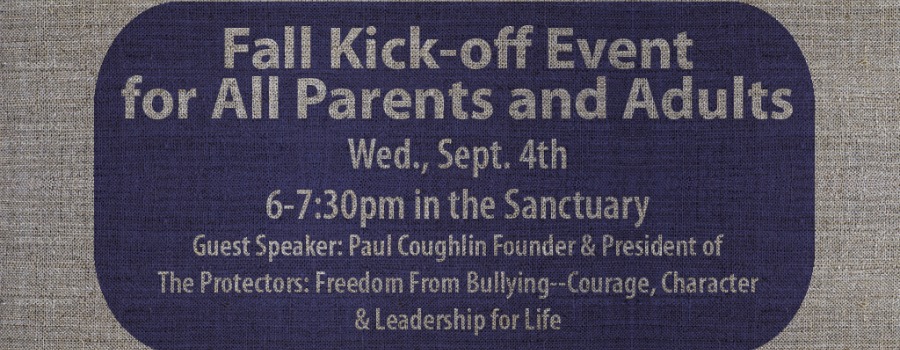
Our partnership with Courageous Communities Against Bullying continues to grow. On September 4, The Protectors will partner with White’s Chapel United Methodist Church to help the community of Southlake, Texas diminish this growing form of intentional abuse that is quickly becoming the leading concern among both parents and students. Join us as we spread The Protectors message throughout Southlake and nearby communities. If you are interested in getting involved in Courageous Communities Against Bullying, contact us here.
posted on August 19, 2013 by Paul Coughlin
 The Protectors has been busy this past year, extending our outreach and helping more children in public schools, private religious schools, and other youth-based organizations throughout the world, most recently adding film to our outreach. It was my privilege to be a consultant and even appear in the upcoming docudrama, Courage In A Time of Fear: A Practical Guide to Ending Bullying
Unlike other films about what is now the leading form of child abuse in the nation, this docudrama goes beyond explaining the problem to offering practical solutions. It premiers at the
Portland Film Festival August 31st, and we hope everyone in the area gets a chance to see the film.
Because of the film’s desire to empower Bystanders to find the courage to speak up and become heroic Alongside Standers of targets–part of The Protectors core mission as well–I’m glad to announce that The Protectors will also be creating a companion study guide to accompany the film, ideal for public schools. This will be released by the end of the year and will further The Protectors outreach into lower-income schools.
For more info on the film, click
here. For updates on The Protectors and all the upcoming changes, sign up for The Protectors newsletter
here.
posted on August 27, 2012 by Paul Coughlin
Sometimes despair is concealed by a long and desperate fuse, as revealed this month in Albany, Oregon, the state in which I live, labor and love.
This month, friends and family of Kaitlyn Boris wonder why the 15-year-old took her life. But Kaitlyn told us why. As in so many cases where bullying is a contributing factor, the answer is not found in a riddle, which is insolvable. It’s found through pieces in a puzzle that those with the right mind, heart and courage need to assemble. One piece of this puzzle is found through the recognition of evil, something many of us no longer believe in—including those in church.
 “I’m ugly. I’m horrible. Everyone laughs at me. … I look in the mirror and can’t believe what I see,” she wrote in notes her parents discovered after her death. We hear this unholy trinity so many times at The Protectors that it is par for the course. We can tell you where she heard such lies: School bullies. They don’t just attack our bodies. Like vampires, they want our souls. ”We’re finding notes saying how she despised herself,” said Dennis Boris, Kaitlyn’s father. And contrary to what many in education, ministry, and psychology tell us, this is the wicked goal that many bullies cherish. They wanted young Kaitlyn to hate herself, a condition that gives serial bullies dark power, perverse pleasure and glee.
What makes Kaitlyn’s struggle so compelling is that she took her life weeks before school began. A girl who talked about suicide before with close friend Kara Russell, Kaitlyn apparently couldn’t bear returning to an environment that few adults if any would tolerate without leaving and then suing their employers. She wrote about “kids tripping her down stairs” and “footballs getting thrown at her face.” Parents, if people intentionally tripped you down stairs at work tomorrow and threw hard objects at your face, would you ignore it? If you told your boss and were told that it’s just how the work world is, would you return? Yet our children hear something very similar every day. Worse, unlike adults who experience bullying in the workplace, our children have no choice but to attend school. And when you believe you have no choice, soon…you have no hope.
What killed Kaitlyn, a little girl who took her own life before the first day of school, who dreamed one day of owning her own restaurant? It wasn’t the 45-caliber pistol. That just made it easier, quicker, and accelerated the fuse. Other girls her age use scarves, electrical cords and the steady, grim pull of weight tethered to gravity. What killed Kaitlyn Boris was hope deferred, which makes our hearts grow sick (Prov 13:12). What killed her was fatigue to her young and abused spirit, a belated death that will be experienced by millions of children each year in our nation alone, children who experience the humiliation, contempt and disdain of bullying and find no meaningful help or relief, as the profound documentary Bully shows. The majority of the Church is slow to respond with more than words. A minority truly cares. And acts. But too many are indifferent to the plight of this needy and oppressed group, which was one of the sins of Sodom and Gomorrah (Ezekiel 16:49). An impressive exception is the Justice & Trafficking Initiative of Saddleback Church and Men’s Ministry Leader Kenny Luck. Another dynamic exception is Bethel Church of Richmond, WA and minister Dave Stavanus.
Having spoken to tens of thousands in churches about this growing evil, I’m often left asking myself, “Where’s the Church? Where are the Christian kids who witness such cruelty? Where are the Christian educators and parents standing against it?” I speak with Christian adults who approach me after I talk about our faith-based solution to adolescent bullying. They tell me their bullying horror stories with tears in their eyes, as if they just happened in the parking lot, when in reality they took place decades ago. The paint in their house of horror doesn’t dry. And when I tell them that they can help others like Kaitlyn escape what they went through—we never hear from them. They cry, wail, judge, condemn—but they don’t help lift the burdens of others. They mistake cursing such darkness as an act of creating light. Where is their faith and love in action?
If you judge this as hyperbole, consider the following. This August and September, in your city, town, province or neck-of-the-woods, a minority of students will go shopping, but not for school supplies or clothing. I’m talking….prey. They will shop for those to dominate, control, attack, and humiliate. The majority of these bullies will be met with no resistance from kids who attend church. Statistically, they will be supported by kids who went to Sunday School that week, that month. The majority of these church-going kids (about 60%) will be party to what is currently an unrecognized expression of evil when they watch, point, laugh or otherwise egg the bully onto greater acts of abuse.
Needless to say, people are leaving the Church due to its anemic response. Writes Wendy: “Bullying is why we finally left the church for good. Our special-needs child was being picked on by ‘good Christian kids’ in Sunday School and youth group. Thankfully he doesn’t have the self-awareness to be cognizant of the cruelty that they were displaying, but his sister does, and even though she alerted ‘good Christian leaders’ as to what was going on, NOTHING was done. After several kids picked on both brother and sister (sister for the apparent crime of having a special needs sibling?…), and several emails/phone calls that fell on deaf ears, we were outta there.
We’ve never experienced the kind of cruelty, hypocrisy, and judgment that we’ve gotten within the church outside its walls; in fact, quite the opposite. I agree with what you’re saying about Christians being more kind…but I’m not holding my breath for it to happen and I’m certainly not going to put my children in the cross-hairs of people who have already shown their true colors.”
What killed Kaitlyn Boris? We know this much. Her wounded spirit remained hidden from her parents and friends. It festered, spiraled and grew increasingly fearful, sorrowful and grief-stricken. Fear consumed her young and fertile mind. She felt she had no other option, a lethal and naive belief. But when hope vacates our minds and tender spirits, all things become possible.
Beyond this we are left to speculate, but an educated speculation. There is a strong chance that kids who went to Sunday School, who memorized Bible verses and who prayed to God saw what happened to Kaitlyn and did…Nothing. Many wanted to help, but were too cowardly, which is a sin (Rev 21:8).
Fellow parents, we have settled for low-grade goodness, measuring our performance by what we avoid—not by how our hearts overspill with gratitude toward Christ, how we help others in need because they are made in His image, and how we love because Christ commands us to. And we are diminished by following this easier path more traveled. We instruct our children to avoid bad words, bad movies and bad company, but we neglect, as Jesus admonished with some of the most powerful words from His mouth, “the more important matters such as justice, mercy and faithfulness.” Parents, we blind guides, we strain out a gnat but swallow a camel (Matt 23:23).
Because of this, but not only because of this, families continue to be torn asunder, communities mourn and receive no substantial salve, and the enemy of our soul walks laughing. It’s well past time to fight like Christians, the way Kevin Curwick has, a high-school senior and captain of his football team. Frustrated and indignant about cyberbullying, he started a Twitter account that exalts the positive qualities of his classmates. His effort to employ the cache of athleticism and the popularity it affords is spreading to other schools. This could be your school. But we must be faithful, willing and courageous enough to be different than the rest, and to live with the criticism that comes from non-conformity. Athletes in Action, Fellowship of Christian Athletes, and related organizations, you could lead the way in this righteous cause.
posted on July 31, 2012 by Paul Coughlin
Former and self-professed “mean girl” Jennifer LaFleur was fortunate. Her high school art teacher knew that what Jennifer really needed wasn’t more self-esteem, a common error among those who work with youth. Like most serial Bullies, Jennifer’s cure came in part through seeing her own dominating behavior in the theater of other lives, so her teacher made her a peer advisor for younger mean girls. Jennifer saw herself in their selfish and cruel eyes and saw the light.
But this wasn’t the only ray of unbecoming light that brought sobriety. Jennifer crossed paths with Debbie, a more powerful bully, giving her the gift of insight and humility. Still, it wasn’t till after high school that Jennifer self-diagnosed herself as a full-fledged bully, a fact she hid from her mother.
The Canadian psychotherapist, who was not reared in an abusive home, began the difficult work of making amends for her past sins and transgressions. She called Tracy, the girl she drove from class by coercing 10 other girls to sign a contract to hate her. “I know who you are,” Tracy said, seconds into the phone call, stunning Jennifer. Does anyone forget the name or even the voice of their tormentor?
“I explained to her that it was me who had the issues, not her,” Jennifer said during her compelling interview with the Canadian Broadcast Company (CBC). She even flew to America to have lunch with Tracy, making her apology more genuine and life-giving. Jennifer shatters the “All-bullies-have-low-self-esteem” myth when she admits, “I was selfish and self-centered, which stops you from having sympathy and empathy.”

This former tormentor now helps Targets of bullying and children who bully–a hard nut to crack. Most kids are unwilling to admit they bully even when confronted with a mountain of evidence, she says. And she laments that one of the hardest parts of her job is to get their parents to admit it as well.
She says Bullies have high self-esteem derived from wrong values. They base their esteem on power and control, not merit or achievement. She says Bullies need guidance using their power for good. They need to experience how good it can feel to help people instead of using that same power to harm them. And if your child is the Target of such a Bully, please resist the well-meaning intention of helping the Bully complete this difficult task. Such an effort sounds “Christian,” but is often met with great frustration since you probably lack the prerequisite power or respect in the life of such a kid.
And if you are among the minority of parents with the humility and courage to admit that your child is a Bully, consider enrolling her in service work, preferably in another country where there is a language difference. This fosters humility through dependence upon others for daily help, and at the same time allowing her to help others, which can aid sympathy and empathy.
Among the numerous myth-shattering lessons to be learned from this reformed mean girl is that when we think of the common facial expression of the garden variety Bully, we must disregard the misconception that it is a frown born of dangerously low self-esteem or an Inner Broken Child. Rather, it is a sardonic smile, born from self-love, self-admiration, and the pleasure and entertainment some receive by dominating and humiliating others. If an adult behaved this way, we would call such a person a sadist, criminal or both. But for some reason we cannot bring ourselves to make the same judgement when dealing with an adolescent, who statistically is headed toward a life of crime. We are not being compassionate when we think and behave this way. We’re being ignorant and worse, derelict in our duties as adults, allowing harm and abuse to take place unabated under our very nose. We may fool ourselves but not God, who requires us to stand against such injustice.
BULLYING: THE ONLY FORM OF INTENTIONAL ABUSE THAT WE TELL THE MOST VULNERABLE AMONG US TO “JUST IGNORE.”
posted on July 17, 2012 by Paul Coughlin
Throughout history, if you were to ask the sages of a given culture why people do bad things, you would be told that somehow, someway pride and selfishness were leading culprits. In fact you will still hear this answer throughout most of the world today–except in America and a minority of related nations.
Our great country is at the tail end of what was a seemingly large-souled campaign and compassionate experiment. We have gone against the grain of thousands of years of belief and created a bold, intriguing and seemingly humane hypothesis: People actually do bad things because they feel badly about themselves. The remedy, we’ve been told for nearly 40 years, is a heaping dose of greater self-esteem.
So how’s it working? Has “positive discipline,” having students write stories and poems about how great thou art, peer mediation, and a host of other programs designed to combat bullying in our schools actually transformed the minority of children who bully into better people?
Though it is true that “hurting people hurt people,” a growing body of research tells us that this is not the main reason why people become serial Bullies. Your average Bully does not feel badly about himself or herself. Your average Bully actually possesses average to excessive self-esteem. Many Bullies intentionally harm others with superior power and over time due to self-love, not self-hate, as Dr. Roy Baumeister among others continue to show us, even though we seem to have limited stomach for such an old-fashioned belief anymore–an aversion that will continue to tear at the tapestry of our culture until we adopt a wiser orientation to this growing problem.
Enter Exhibit A, Jennifer LaFleur.
The Canadian Broadcast Company (CBC) interviewed LaFleur earlier this year. She was a self-professed “mean girl” for most of her school years. Now she’s a psychotherapist who helps Targets escape bullying. During this myth-shattering interview, she admits that she was “selfish,” “self-centered,” did not come from a “bad home,” and was intoxicated by the power she once wielded. As proof she admits how in 4th grade she created an all-girl’s-club for the sole purpose of excluding and harming another girl who did nothing wrong to LaFleur. She drafted a contract that she demanded 10 other girls in her class sign, swearing to “hate” this other girl. All 10 signed it (When you wonder what kind of person joins a dangerous cult, or how seemingly “good kids” can be so cruel, think about this incident. And chances are some of those girls went to church that week, that month.)
What made this cruel and abusive Queen Bee change her bullying ways? An autobiographical essay proclaiming to herself and the fortunate world how great she really is? Penning a song of admiration about her wondrous Inner Butterfly? Positive discipline on behalf of well-meaning Authority? The answer to this and more in the next installment.
Bullying: The only form of intentional abuse we tell the most vulnerable among us to “just ignore.”
posted on July 12, 2012 by Paul Coughlin
Meet bullying Target Jason Carroll Moss, 38, who shortly before his 20th high-school reunion last week in San Antonio threatened those who bullied him and was arrested.
“I stayed away from graduation at the time because I would have started the Columbine shootings early,” Moss allegedly wrote on the San Antonio high school reunion’s social network page. “I was picked on and bullied by a bunch of you when I went to school and I wanted to kill everyone that hurt me.”
Moss continued, “I’m still seeking vengeance on all those who bullied and harassed me when I was growing up or went to school. You people do not know what you did to me.” Studies show that his last point is completely and sadly solid.
Detectives arrested Moss, who confessed to writing the rage-filled post and said he did it because the fear he experienced then in school has not died. He worried and probably obsessed that two decades later he’d be abused again.
The party went on as usual at a local country club. We can assume that Moss was the subject of a lot of conversation, speculation, and derision, at least by some. But what about those who bullied him? Were their names run through the mud? Was their behavior spoken of honestly and with the same fervor and derision? You can bet it was not.
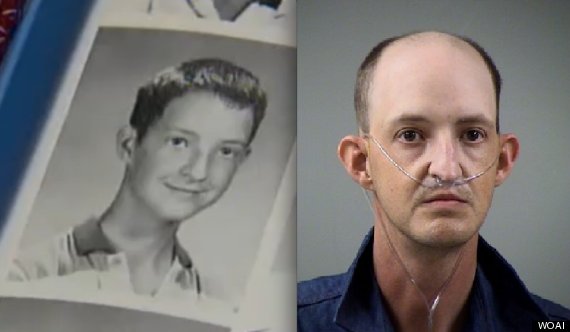
Jason Carroll Moss then (yearbook photo) and now.
If you’ve been bullied, you know how hard it can be to forgive–especially when those close to you don’t have a clue how you felt, what you endured, and what you continue to ruminate over even 20 years later, like Moss.
But you have to try and, thankfully, it’s a process, which takes some of the pressure off. You will make progress, fall back, but then if you are committed to your own well-being and not the reformation of your tormentors, you will wake up another morning and get a few more footholds on Mount Forgiveness. And speaking from personal experience with both mountaineering and struggling to forgive, unlike most mountains that get harder to climb the higher you go, this one gets strangely easier–not easy, but easier. After a while, you no longer feel like you’re climbing because, well, it just doesn’t matter as much as it used to.
Studies show that people who forgive are happier and healthier than those who hold resentments. The first study to look at how forgiveness improves physical health discovered that when people think about forgiving an offender it leads to improved cardiovascular and nervous systems. Another study at the University of Wisconsin found that the more forgiving people were, the less they suffered from a wide range of illnesses.
Remarkably, we humans put forgiveness–the ability to halt resentment, indignation or anger due to a real or perceived offense, or ceasing to demand punishment for such an offense–up there as not just a want, but a need. Problem is, we often don’t know how to get there, and we know it. As proof, the Gallup Organization discovered that 94% said it was important to forgive others, but 85% said they need some outside help, including divine help, to obtain it, similar to the way that people who want to lose weight hire a personal trainer–they don’t believe they can get there on their own.
Even more remarkable was how people admitted that regular prayer didn’t help them forgive. What truly helped them was meditative prayer, the kind that Martin Luther King committed himself to, not just to help him forgive those who harmed him and his beloved family, but also those who were committed to harming the people he longed to liberate.
Instead of thinking in terms of burying a hatchet, those of us who have been bullied should think in terms of burying the poison. Because un-forgiveness is like drinking poison ourselves and expecting our Bully to die. Thankfully, forgiveness exists in two flavors, like scoops of ice cream on a cone: Decisional, where your mind leads instead of negative emotions, and you choose how you intend to act or would act if you had the chance; and emotional forgiveness, the emotional replacement of negative, unforgiving emotions with positive, other-oriented emotions.
Emotional forgiveness is superior, more difficult, but not required for good health and right standing with God. In the New Testament, we see that God desires us to emotionally forgive because God loves us and wants us to be free from the snares of our oppressors, but He does not require emotional forgiveness. For many, this is a refreshing drink of soul water.
And forgiving another does not mean that the Target must reconcile with his or her Bully. “Reconciliation is resurrecting trust,” writes Everett Worthington Jr., Ph.D. a former executive director of the Templeton Foundation’s “A Campaign for Forgiveness Research.” “Reconciliation,” he writes, “depends on whether people believe that each will act trustworthy and not re-injure each other.”
What would have helped Moss avoid this decades-long nightmare? If the countless Bystanders who witnessed his torment did the right thing, the heroic thing, and intervened. As the numerous letters to our organization attest, many such witnesses as adults harbor great regret and self-recrimination to this day. They are unable to live with themselves for having succumbed to such dark peer pressure, or as today’s youth put it, how they became the Bully’s “tool.” They lament their cowardice, their indifference and their unwillingness to do the right thing afraid and help Moss and others like him. They know, though they often cannot fully explain, that such timidity in the face of blatant injustice and cruelty stole a part of themselves, the better part. It’s well past time to cultivate and celebrate the morally courageous among us. It’s time to cultivate and celebrate such heroes. They’re out there–they just need some tools, some inspiration, and a sense of responsibility that he ain’t heavy, he’s just like me.
 For a quick but powerful beginning step in this life-changing process, read Everett L. Worthington Jr.’s small, 31-page booklet, “How Do I Forgive?” [IVP Books].
posted on June 5, 2012 by Paul Coughlin
When we began The Protectors freedom-from-bullying movement about eight years ago, some thought it was a good but not necessary creation–like places that change your vehicle’s oil. Now according to a recent Harris Poll, bullying is the #1 concern among both parents and students–surpassing sex, drugs and gang activity.
Hardly a week goes by now where bullying does not make it into our nation’s media and our collective mind and worry, reminding me of that ominous phrase: You might not be interested in war, but war is definetely interested in you. More and more studies reveal that this intentional form of abuse affects most everyone the way a stone creates waves through water. It’s as if we’ve been re-introduced to an old enemy that we thought we knew but didn’t, leading to anxiety, and hardly know how to resist, leading to paralysis and even more anxiety.
But there is a way out, which is what this fresh blog is all about. This path toward freedom, justice and the defense of human dignity is forged by helping all four “characters” in the “Theater of Bullying” (Bullies, Targets, Bystanders and Authority) change their role. Because life really is a movie. And when it comes to bullying, the ultimate question is: What role will adults as well as children play?
And let me leave you with this distilling insight, which will help you understand the primary goal and orientation of this new blog: Knowledge alone will not transform this problem any more than consuming one lone vitamin leads to health. Knowledge alone does not set captives free. We have plenty of knowledge about bullying–some of which is conflicting. Our children, their parents and their teachers don’t need another Ph.D. to tell them that bullying is wrong and harmful. This is confirmed within the blacksmith of our troubled souls. What we lack and what we need as a people is the will, courage, conviction and indignation to confront it and diminish it. This will require sacrifice and for some, suffering. Some will rise to this noble, life-affirming challenge and some will not — just like the characters in our favorite movies.
So welcome. Let’s change history within history, and in the process grow courage, character and leadership for life, not just for the children in our lives, but for the adults as well.