The Protectors

Practical Ways to Defeat Bullying in Your School

BY PAUL COUGHLIN |

Their letters are separated by zip code, but united through bewilderment and feelings of betrayal from the organizations they believed would protect their child from bullying—the leading form of child abuse in the nation, and the only form of abuse we tell the most vulnerable among us to “just ignore.”

Their pleadings are almost always composed by emotionally flailing mothers who witness a common but mystifying tailspin of their beloved child, a spiral born from intentional abuse that weds power to fear, making it formable, and due to its predatory nature impossible for Christian school teachers and faculty to effectively combat alone. One bewildered mother writes:

Dear Protectors:

My 6th grade son has hemophilia. In 4th grade, he was bullied so bad by a child the school let in (after being kicked out of public schools) that he actually wrote a letter to his teacher stating he wished he were dead. He isolated himself and refused to eat. Was mad all the time and wouldn’t talk. This year he is being bullied verbally, emotionally, and now physically by the majority of students in his class. He has no self-esteem and doesn’t fight back. I worry constantly that he is going to kill himself. He sobbed to me for hours tonight and I still have not been able to get him to eat.   

I refuse to go through the whole process over again of “let’s try and save the bully and worry about him”… This was the answer I received multiple times when I asked how exactly they were helping my son. In the process of “saving” or attempting to save the bully, they lost my son. I need him back. He is an amazing kid. I purposefully put him in a Christian private school so that the attention would be more focused on school, rather than sports, which he cannot do due to bleeding disorder.  

Please, please lecture these students and make them understand not only the damage bullying causes, but also just how not Christian like that this is. I need someone to take this seriously. It is killing me watching my son so totally miserable.

As an expert witness regarding bullying and the law, FoxNews contributor as well as the founder of a freedom-from-bullying program used in public and private Christian schools, I have become a Moses to these bewildered parents, guardians and their bruised and sometimes bludgeoned children. For some, bullying is their first real experience with profound injustice, wickedness and in more extreme cases even evil. These beleaguered mothers are desperate for practical help and a sustaining hope.

Atop our list of freedom-from-bullying advice and insight to them is: Bullying pays in a youth culture (including Christian youth culture) where unkindness, meanness and even cruelty are currency, making it a cultural, not a school, problem. So if we are serious about fighting bullying like Christians, which is speaking and living the truth in love, then all of us—not just teachers—must labor to change this false currency. More so, parents (not teachers) are the front line of defense against such abuse for reasons explained later.

Much like our culture in general, such parents do not want to hear this. They want a quick and easy fix to their ongoing misery, and so do I. But having studied and battled this specific and greatly misunderstood form of abuse, I know an irritating truth: The right thing and the hard thing are usually the same thing.

Diminishing bullying is hard, but doable. And it starts in the home, not the classroom.

A recent study [Jan. 2013] from UCLA confirms this perverse maxim, which is confirmed by previous studies as well. Middle school “students who were named the coolest at one time were largely named the most aggressive the next time, and those considered the most aggressive were significantly more likely to be named the coolest the next time.”

The results indicate that both physical aggression and spreading rumors are rewarded by middle school peers.

“The ones who are cool bully more, and the ones who bully more are seen as cool,” said Jaana Juvonen, a UCLA professor of psychology and lead author of the study. “Pushing or shoving and gossiping worked the same for boys and girls.”

This perverse power transcends middle school. As more and more teachers attest during our teacher training sessions, this currency of cruelty that helps define bullying is being spent in the early elementary school years, throughout high school, and even further into college, a sobering and unprecedented expansion.

Educators didn’t hire lobbyists, consultants and ad agencies to convince the world that it’s cool and beneficial to be cruel toward others. But they are expected to get rid of it largely on their alone, an expectation that is as unrealistic and naive as it is unfair since cultural norms enter our schools each day like dirt on a student’s shoe. Still, this immature expectation persists, which educators must wrangle with the wisdom and shrewdness of serpents, pulling in parents and others of goodwill during each opportunity.

The Real World of Bullying

When Jesus said that the poor will be with you always, he may as well have added bullies, too. We will never “get rid” of bullying because in order to do so we would have to rid the world of the sins that sustain it, which are formidable. They include arrogance, pride, hubris, contempt and related sins such as “cupiditas,” for which Dante reserved the lowest levels of hell. Also called the “sins of the wolf,” cupiditas describes the kind of behavior and person who consumes others.

To the minority of students who become serial bullies and unleash the most harm, people aren’t people. They are commodities and tokens for barter, a disposition usually gained through the umbilicus of parental modeling [bullying can also stem from lack of parenting, especially male parenting]. When it comes to bullying, this exchange includes refining the pain and suffering of others into personal pleasure, power and domination as well as social capital, the cherry atop of this forbidden desert.

Bullying stems from profound spiritual maladies and requires powerful spiritual surgery instead of feel-good, pop-psychology bandages. Studies show that through word selection, body language and related behavior that your average bully not only received pleasure from another’s pain (the definition of sadism) but also believes she is superior to others. Bullies need a major infusion of humility, not greater self-esteem, which is already inordinate among bullies.

The good news is that when Christian schools help targets, bullies and bystanders undergo this deeper but more penetrating soul work through the portal of justice and real peacemaking, they facilitate some of the most powerful spiritual formation possible, including greater faith, wisdom, hope, love, humility, courage, and compassion.

This shameful economy where unkindness, meanness and cruelty pays isn’t limited to youth culture. Celebrity chef Gordon Ramsay is worth an estimated $50 million and receives $225,000 per tv episode in part for demeaning and abusing others. Like so many bullies, he gains the world but loses part of his soul each time he unleashes a hurricane of obscenities upon a stunned pupil for the unforgivable sin of overcooking or undercooking, or for defending themselves against his verbal body blows and jabs of acrimony. Worse, he receives this filthy lucre because many adults find this verbal blood sport entertaining–exactly the way students from Christian school receive glee when a fellow student has her physical or psychological skin seared through physical, verbal or cyberbullying.

Immature and cruel youth culture reflects immature and cruel adult culture, so Christian schools fight an uphill battle against such abuse that restricts equal access to an education, lowers test scores and school spirit, increases truancy and psychological and spiritual fragmentation, and tarnishes the good reputation of their school, often unfairly, among the many other ailments that accompany this intentional form of abuse.

Then there’s school violence. The Secret Service interviewed 37 school shooters (some in Christian schools) and found that nearly all (85%) said they did it as revenge against bullying. Agents said their experience met the legal definition of harassment and moral definition of torment. Children are being tormented each day in Christian school and minority experience relief, in part because only about 10% of victims of abuse in general ever talk. The majority conclude that if there is a God then He must not care about them personally or justice corporately.

Yet within this “Theater of Bullying,” there is a silver lining, especially for Christian schools, which aren’t as beleaguered by red tape than the public schools and are better able to speak to the deep spiritual issues that maintain and promote bullying. Tackling bullying is a hidden opportunity for demarcation and greater enrollment if handled with acumen. Addressing bullying, far from an admittance of guilt, makes good business sense. Not only will Christian school’s help bring God’s Kingdom to the world through anti-bullying efforts since justice is love’s most public and becoming face, it’s an opportunity to distinguish themselves from less discerning educational opportunities, a distinction that with time will bolster their enrollment through greater student retention and attraction. “Hardly a week goes by when I don’t have a conversation about this topic,” says Larry Taylor, Head of School at Prestonwood Christian Academy in Plano, TX. “Parents who are thinking about having their kids attend our school want to know what we are doing about this problem.” A Harris Poll [Sept 2011] confirms this growing worry. It found that bullying is the leading concern not just among parents, but students as well, surpassing illicit sexual activity, gang activity and drug use.

Practical solutions to defeating bullying in Christian schools

To combat this churning anxiety among parents and students, think comprehensively. Students, faculty and parents must realize what bullying really is and their role in diminishing it. To start, the word should be stripped from the Sports Page. As a varsity soccer coach, I know that teams don’t bully one another. They beat one another in the theater of sport through aggression, strength, skill and cleverness–and sometimes merely good fortune. They do not strip an entire team of dignity and healthy self-regard. And just because a child gets his tender and sometimes excessive feelings hurt (often the product of over-protective and indulgent parenting), doesn’t mean he is targeted. It could just be a case of conflict, misunderstanding and related problems that do not constitute bullying and require different solutions.

Though definitions vary, most agree that this intentional and predatory form of abuse is the deployment of superior power (physical, economic, relational) to intentionally harm another multiple times and for no good reason. It’s victimization without provocation and often includes humiliation, isolation and audacity on behalf of bullies, who are more motivated by contempt and disdain, which are usually longer-lasting than anger, helping to explain why bullies can be so tenacious in their campaigns of cruelty.

There are so many misconceptions about the word bullying that schools and culture in general would be better served by using an alternative. Since bullies wed power to fear, the word terrorizing is pretty accurate. So are hating since most bullies look down on targets, and assaulting, since bullies violate a person’s physical and psychological well-being.

Yet even in this theater of bullying where all is not as it appears and where most targets are more sinned against than sinner, God through his grace may have built in a kind of Achille’s Heel into this abusive behavior that courageous and wise administrators can exploit to help foster God’s love, compassion and justice throughout their school.

Martin Luther King wrote that injustice and its related evils carry within themselves the seed of their own destruction. When it comes to bullying, this seed is the audacious nature of many bullies, who contrary to popular myth do not suffer from low self-esteem but rather inordinate self-regard. They behave badly for many reasons, and one of the least recognized is self-love, not self-hate.

More times than not bullies believe they are more or the most intelligent, skilled and popular child in their class. They believe they are superior to others and hold others in contempt and disdain. Like the dictators and despots throughout history, deep inside they believe that others deserve to be treated poorly. Phillip Yancey, while denouncing the racism of his fundamentalist youth, wrote that “Black people gave us [Southern Christians] someone to look down on, someone to mock and feel superior to” [Soul Survivor, page 14]. This same dark impulse to feel, think and behave superior to others is alive and well throughout the hallways, cafeterias, locker rooms, stair wells and playgrounds of Christian schools–all hotspots for bullying.

If one doubts this unsettling statement, consider this: physically and mentally challenged children are among the most bullied in any group gathering. Many have no relationship to their bullies, so there is no “conflict,” “miscommunication,” or “misunderstanding” Like African Americans under Jim Crow, physically and mentally challenged students are seen as children of a lesser god, unworthy of basic respect and dignity. As former professor at Notre Dame, Yale and Harvard Henri Nowen explained, if our ability to think is our singular capacity that makes us fully human, how then should we treat those who do not fully possess this capacity? Are they fully human? Our unofficial and shameful answer, both inside and outside of Christian culture, is a resounding no. Of course we do not say so with our words, but we do with our behavior through the unvarnished and brutal portal of the human heart called bullying.

Bystander to ‘Alongside Stander’

“Blessed are the peacemakers,” Jesus said, “for they shall be called the children of God” [Matt. 5:9]. Remarkably, the word peacemakers here does not imply pacifism, unlike other sections of the Beatitudes. Instead, it refers to those willing to resist and actively bring conflict to an end.

Today, when it comes to bullying, we create much peace-faking, little peacemaking. Think, for example, how many times abused targets are forced to shake hands with their bully oppressor, as seen in the gripping documentary Bully. To help your students become real children of God, help them fight like Christians: those who are assertive but non-violent in the face of persistent injustice and sometimes evil.

A 10-year, landmark study by the Department of Health & Human Services revealed that most school-based, anti-bullying efforts are ineffective; some even dismal. The reasons vary, yet atop the list is that efforts to reform bullies through popular and more feel-good measures such positive discipline and peer mediation did more than fail: they put more power in the hands of school bullies. This study recommended that the best but also hardest route to diminishing bullying is to leverage positive peer pressure through bystander intervention.

Studies show that the vast majority of school-aged kids recognize bullying, feel sympathy and empathy for targets–yet they don’t act upon what they know and feel is right. Only around 13% help the target as 40–60% support the bully either overtly (“Hit her again!”) or covertly by snickering, pointing or giggling at the target then or later.

When we know and feel something is wrong and it’s within our power to act but don’t, most of the time it is due to the lack of courage, or to put it another way, the sin of cowardice [Rev. 21:8]. To transform passive, conflicted and often sinful bystanders into righteous and even heroic “Alongside Standers,” students who assertively but non-violently intervene, we must grow our student body’s capacity for courage, the virtue that many such as C.S. Lewis argued underpins all others.

Courage and moral strength are tethered throughout the Bible and across cultures. Sign language for courage is two clenched fists, a symbolism that is practically synonymous with strength. and Jesus told us that the greatest of all commandments includes our capacity for strength as well, a connection we hardly recognize in what he said is the greatest of all commandments: “Love God with all your heart, with all your understanding and with all your strength, and to love your neighbor as yourself” [Mark 12:33, emphasis added]. Here in we find our triad human capacity: think, feel, act. Schools [and churches] have focused too much on the first two but hardly on the third. Your anti-bullying efforts will continue to be truncated until you do.

Your children will commit such righteous and heroic deeds when prepared what to do before they witness bullying through roll play, and by giving them the right script to follow. One success story comes from 5th Grade Teacher Diane Alosi of Silverdale Baptist Academy in Chattanooga, TN:

One of my students, Melody, heard a student bullying another student. Melody, a smaller child, walked up and spoke boldly, using words straight from the Protectors Program. When Melody shared this with our class, her classmates spontaneously, without my direction, stood up and applauded her. Melody and the former bully are now friends and together they help defend other classmates!

I have had the great pleasure to meet this young protector as part of a 700 Club feature story about our faith-based program. When filming wrapped, she walked up to me and said it was an honor to meet me. “Melody,” I said, “it is my honor to meet you. I want you to run for President someday because we need more people like you leading our country.” Though small in size, Melody is large in character and esteem among her peers. Her eyes are deep, strong and steady, lion-like, which is the international and historic symbol of courage, the same symbol Lewis chose to represent Aslan, his Christ-figure in Narnia.

Power of Two

One Oregon study reveals that like Melody, if one student (and they don’t have to be large in size or even popular) uses assertive but non-violent words such as “Stop,” “That’s wrong,” that bullying can end almost 60% of the time and within 6–8 seconds. We take this amazing dynamic even further, in part through a profound Greek Proverb: “Only the gods are courageous in isolation.” Jesus showed this kind of courage in the Garden of Gethsemane–but he was divine. The rest of us need others to bolster encouragement, which means to comfort and to urge forward. This may be one reason why Jesus sent his disciples out in tandem.

Have your students make an agreement with another student that they will defend each other from bullying, but then here comes the school-culture-changing part: Together, when they see another bullied, they will intervene on their behalf. During the same 700 Club taping, I met two boys who used the power of two on behalf of a bullied boy with Aspergers. He was considering leaving the school and his grades plummeted. But that was before these two protectors changed his life through courageous, assertive but non-violent words and deeds.

More Than Preparation: Parental Expectation
But preparation is only half of the equation to turning passive bystanders into heroic alongside standers who will change the culture of your school and in doing so, transform spiritually as well. The other half is expectation, as in parental expectation. Parents must expect their child to do something positive when they witness bullying, such as direct intervention, reporting [not tattling] to authority, comfort the target, and so on. It’s for this reason why we know that the most important presentation we give at Christian schools is to parents, not students. Parents far more than teachers are the invisible hand that moves the actual hand of students for good or bad.

I desire to end this series with a sunny example of Bystanders becoming righteous and heroic Alongside Standers, like the protectors of the young boy with Aspergers. Having confronted bullying, they now know how to call a bully’s bluff, making them better leaders now and in the future. Yet as Christian school leaders, you know that bullying isn’t always so easily eradicated. We have left numerous voicemail messages and sent even more email responses to the distraught mother of the hemophiliac boy mentioned at the beginning of this series. No response.

Though we always hope and pray for the best, we also know that in this perplexing theater of bullying there are dark hallways and even darker haunted rooms. Without a protector, his odds are slim, and grow slimmer. He needs someone to help loose the shackles of bullying, the way PE Teacher Sampson did on behalf of a very young Frank Peretti, a gifted Christian writer who accredits this teacher, along with counselor Mr. Eisenbrey, with saving his life from the horrors of bullying: “I can’t overstate the pivotal nature of that day in my life. From that moment onward, everything was so different. I could enjoy school. I could get excited about being a Cleveland Eagle…I got involved in school drama productions–where I could actually use some of the gifts God had given me–and I burst out of my shell, making lots of new friends, and just going nuts being creative” [The Wounded Spirit, Frank Perreti,].

Culture isn’t getting kinder, more loving or humane. We believe bullying will worsen in the coming years, but get better within pockets of resistance, and Christian schools can lead this resistance. “I have been in Christian education for more than 20 years. And one of the changes I’ve noticed is that the crassness of our culture is seeping more and more into our Christian schools,” a wise Christian school counselor told me recently. “We’re seeing problems we didn’t see before, including bullying.” Instead of hiding from it, she said that Christian schools need to adjust to these changing challenges by bringing a new expression of God’s love and wisdom to it.

Some Christian school leaders will have to contend with unaware board members who do not have daily contact with the world of students, and who believe “bullying doesn’t happen here.” As one ACSI-accredited teacher told us recently, “We seem to be moving past this belief that bullying doesn’t happen in Christian schools. Of course it does. Instead of putting our heads in the sand, we need to show our students, faculties and families how to transcend it.”

Another obstacle is more practical: covering the cost of implementing a freedom-from-bullying program, which can be expensive. To help alleviate the cost, make your anti-bullying effort comprehensive and curricular, not extra-curricular. Your parents already pay for curriculum in additional to tuition. Far from an admission of guilt, most parents will be glad to pay for a program that provides greater school safety, spiritual formation, character development and leadership growth.

And as a board member of a private school myself as well as a varsity soccer coach, I know that school’s spend far more money on uniforms for just one or two sports teams per year than on a comprehensive solution to bullying, the same program that can pay for itself by retaining just one student’s tuition who would otherwise leave their school due to bullying. Where we put our money is where we put our values.

Wanting to diminish what is now the leading form of child abuse in the nation without a financial investment is like wanting to remove asbestos from a school building but without paying for the cost of abatement; or more on target, defending your school in court against claims of neglect related to bullying and not wanting to pay an attorney. Bullying is asbestos to the spiritual and psychological lungs of your students. They are more than worth the investment now and for eternity.

Rebuilding the Wall: Protecting Christian Schools from School Shootings

BY PAUL COUGHLIN |

The U.S. Secret Service interviewed more than 35 school shooters and discovered a frightening connection between a student bringing a gun to school and what motivated them to murder classmates and faculty.

While there are a number of motivations, bullying is one. The agency concluded that the shooter’s experience with bullying met the legal definition of harassment but also the moral definition of torment.

Until recently, the vast majority of school shootings have rocked public schools. Then shootings in Minneapolis, MN last week, Madison, WI, in 2024, and in Nashville, TN, in 2023, shattered a tenuous wall of protection for Christian schools. Now, Christian school leaders are searching for best practices to safeguard their school communities.

Thankfully, there are effective steps they can take to harden their campuses against this form of predictable, preventable violence.

Best Practices

Convert Bystanders to Protectors

The Department of Health and Human Services conducted a 10-year, landmark study of anti-bullying efforts in America and found most to be ineffective when they reply on authority alone to change the hearts, minds, and souls of children who enjoys dominating and controlling others through harmful behavior multiple times (the blue-collar definition of bullying).

Yet the same study found the freedom-from-bullying secret sauce: bystander intervention. Specifically, positive peer pressure. The study found that children who bully really care how their peers think and feel about them, even when they pretend like they don’t. When their peers denounce their behavior in an assertive yet non-violent way, that gets their attention. That is what can change a bully’s behavior now and into the future, reducing school shootings.

But how can this be accomplished? Studies show that most bystanders recognize bullying is wrong and sympathize with the victims but few act. Why? A lack of courage—a foundational virtue. Courage, mentioned about 14 times in Scripture, deserves to be elevated across your school’s spiritual formation efforts. As Hebrews 10:35 reminds us, it “carries a great reward.”

Anonymous Reporting

We’re aware of anonymous reporting not only thwarting potential bullycides but also stopping possible school shootings. Ensure your system is truly anonymous. This will increase participation among your student body (and faculty) and provide your school with legal cover.

Improve Family Virtues

Bullying isn’t merely a “school problem”—it’s a cultural one. Parents and related guardians—not teachers—should be the first line of defense. Unfortunately, studies show that when parents and related guardians don’t expect their child to commit a prosocial response to bullying, their children see their lack of admonishment as tacit approval. Encourage your families to require their children to commit righteous behavior in the face of this form of cruelty.

Encourage three specific responses:

  • Report (not “tattle”) to someone in authority significant events they saw and heard. Remind parents that tattling is about something insignificant designed to get someone into trouble; reporting is about something significant designed to get someone out of trouble.
  • Comfort targets afterward with phrases such as “It’s not your fault” or “There’s nothing wrong with you.”
  • Direct intervention with assertive but non-violent words, such as “Stop” and “That’s wrong.”

I’m reminded of the quarterback at Prestonwood Christian Academy in Plano, TX, who, when he saw an unathletic classmate being bullied by a handful of teammates, sat next to the boy during lunch. His bullies scattered.

Reform Physical Education 

Though physicality is a blessing to everyone, PE class is not. It is often Ground Zero for defeat and humiliation for some students who dread it as it is currently practiced and who are prime targets for bullying. Schools should consider providing different tracks, both highly skilled and others simply recreational. Also, coaches mix up teams to avoid a popularity contest or cliques.

How Do I Forgive?

Forgiveness for bullying (as well as apologies) can drain the pond that becomes a lake of grievance and resentment for targets. Yet according to surveys, forgiveness, which for most is a process, not a one-time decision, is among the hardest behaviors to achieve. So exactly how does one forgive? The booklet, “How Do I Forgive?” by Everett Worthington Jr., shows how from a biblical perspective. Among other insights, he explains how for most people, forgiveness is a mental decision far more than an emotional feeling.

Harden Your Campus

The perpetrator of the Sandy Hook massacre may have chosen that shattered town’s elementary school because, unlike its high school and middle school, it didn’t have police presence.

Weakness invites aggression among the malevolent. So, for schools that can’t afford an SRO (School Resource Officer) or related forms of protection, consider placing a used police car in your area. Move it around to keep evil guessing. Schools must make securing their entrances to their campus and inside their buildings a top priority.

Challenge Them

Your students want to help targets of bullying, but they usually don’t have a game plan. Part of this game plan is accepting a challenge and being part of a movement on your campus. We call it The Protectors Challenge, and in order to become a Protector, a student pledges to be part of the solution. This includes:

  • Reporting to an authority figure what they saw and heard, especially if they learn about a weapon being brought to school. This is essential since many school shooters brought their gun(s) to school as a test run. They even told classmates about their plan. Most of whom told no one.
  • Joining with another student to stand up to bullying, proven to grow courage and confidence.

Boys More Than Girls

Most school shootings reveal a similar pedigree of grievance, resentment, and untreated trauma. Generally speaking, boys tend to explode when bullied, harming others (even those who didn’t bully them), as girls tend to implode, harming themselves. When assessing potential school shootings, look to boys more than girls (again, as a general rule).

Bullying, like gunpowder, is part of the chain reaction that propels a bullet through a school’s hallway, cafeteria, or classroom. These shootings are evil—and so is the bullying that often precedes them.  Encourage your prayer team to intercede not only against school shootings but also against the destructive cycle of serial bullying. Pray that those who bully would see the image of God in the people they target. And because many bullies believe they are superior to others, pray that they would be filled with humility, which almost always precedes deep transformation.

Bullying and survival of the so-called ‘fittest’

Image may contain: 1 person

BY PAUL COUGHLIN |

Nearly each time I write or speak about adolescent bullying, the leading form of child abuse in the nation, a stern group of naysayers denounce our work as fruitless because bullying is “too much a part of human nature,” a “manifestation of social instincts,” and part of “the natural selection that governs all of our lives.”

One naysayer was even more brutal. “Bullies are the strong who will always dominate the weak because that’s how natural selection works.”

They promote a dangerous ideology shared by Hitler who wrote that it is the “fundamental law of necessity” found “throughout the realm of Nature [that] existence is subject to the law of eternal struggle and strife…where the strong are always the masters of the weak and where those subject to such laws must obey them or be destroyed.”

So targets of bullying are meant to be tormented by the cruel hand of fate, like Jews, or as Hitler called it, “[C]onformity with the eternal Will that dominates the universe, to postulate the victory of the better and stronger, and the subordination of the inferior and weaker.”

Tellingly, the profile of almost all online keyboard warriors for this brutal ideology are male, presumably seeing themselves as the strong, not the weak, imbuing them with grandeur and purpose.

But are bullies really the strong that these social Darwinists celebrate, and for that matter, is the intellectual underpinning they take from Darwin even accurate?

We know that serial bullies are four to five times more likely to abuse their future spouse and children, and five to six times more likely to commit a felony by their middle twenties.

Sean Mulveyhill, now 26, was at the center of the Phoebe Prince bullying catastrophe at South Hadley High School nine years ago where Prince eventually took her own life. In March of 2019, Mulveyhill was arrested on rape allegations leveled by a student at Mount Holyoke College, where he worked as a bartender (He was arrested, along with his brother, for shoplifting on October 23, 2009).

Anyone who knows the real world of bullying isn’t shocked by this development. We expected it. But more to the point: How due run-ins with the law, a damaged reputation, and spending time in prison make you stronger, better and more powerful than others? Remember, it’s the “strong” who reproduce, seeding their superior DNA. Yet we also know that women are drawn to confident men, not abusive nor brutal ones. So exactly how do prisoners, many of whom abusive, have a greater chance at reproducing than non-prisoners? Have fun trying to explain that one to stay in goose step with Hitler’s eternal Will.

The facts create a very different narrative. Bullies, almost all of whom are arrogant and narcissistic, strut for a while, then are often cut down and sequestered through powerful confines such as laws and social norms. Aggression and brutality may equal domination, but they don’t lead to success through wealth, power or reproduction, in part because such narcissists are less successful in the long term because they set unrealistic goals, take stupid risks, and alienate others (Jean Twenge, The Narcissism Epidemic).

Charles Darwin himself wasn’t even “fit.”

He was laid up for days on end with stomach problems, headaches and heart symptoms. For the rest of his life, he was repeatedly incapacitated with episodes of stomach pains, vomiting, severe boils, palpitations, trembling and other symptoms. The source of his illness is not known, though some experts suspect it was the result of heart complications.

So how did this unfit person even survive? Through a force more powerful than natural selection: Compassion. He was nursed back to health, or degrees of health, multiple times by his cousin, Emma Wedgwood, whom he married.

This year, a list of more than one-thousand PhD scientists were publicly added to the report called “Scientific Dissent from Darwinism,” intellectuals who courageously declare their skepticism in the face of absolutist evolutionary theory. The signers hold professorships or doctorates from Cambridge, Oxford, Harvard, Berkeley, MIT, UCLA, the University of Pennsylvania, and many other prominent institutions. Supporters of this list emphasize the world publicly because there are more scientists who would add their names, but fear it would cost them their careers. Darwin (much like Freud before him) is under fire by people far smarter than your average bear.

Bullying does not begin with anger. It begins with the Hitleresque belief that I Am Special. Above the herd. Meant to rule, superior and entitled. By promoting their populist version of survival of the fittest (a phrase first used by Herbert Spencer), they inject more justification for bullying into our already severely damaged culture. This may be one reason why we’re witnessing a rise in anti-Semitism.

A far more humane truth is before us when we consider strength and its actual relation to bullying. It’s the people who stand up to bullies who are the truly strong, those with the moral fiber and inclination to stand against this brutal form of abuse rooted in the same soil as racism, bigotry, sexual harassment and even genocide.

For some, the paint on the walls of their house of horror due to adolescent bullying just won’t dry, even into their later years. This is true for best-selling Christian fiction author Frank Peretti, whose parents, like millions of other parents, burdened him with the most tortured Scripture in the theater of bullying that also leads to untold miscarriages of justice within Christian education as well.

“I came from a Christian home that believed in nonviolence,” says Peretti, “where I was told to ‘turn the other cheek,’ and where if someone abused me, I was supposed to take it. I remember specifically in grade school, this boy shoved me to the ground. I sprang up and got face-to-face with him. But there was this barrier I wasn’t allowed to cross. I wasn’t allowed to defend myself, so I just glared at him. From then on, he knew he had an easy target because he knew I wouldn’t resist him. He bullied me for years, and it was a direct result of the teaching that I got at home.”

The fruit from this popular, well-meaning but naive prohibition, he says, was devastating. “It actually worsened the problem and opened the floodgates to more bullying, which followed me. Once you get the reputation as a target, it’s like a cosmic vibe where, from grade to grade, you’re the one. Word gets around. The turn-the-other-cheek posture reinforces it. When you aren’t allowed or don’t know how to protect yourself, it projects. Like wearing a sign. It shows in your timid personality. It enhances bullying and feeds the problem.”

TURN TO HIM YOUR LEFT CHEEK

There is no more popular Bible quote, nor more prevalent Bible confusion within Christian education, than Jesus’ admonishment to “turn the other cheek.” Yet when kept in context within the two other pertinent examples that surround this somewhat cryptic phrase, we are better able to minister to the most hurting children among us:

“You have heard that it was said, ‘An eye for an eye, and a tooth for a tooth.’ But now I tell you: do not take revenge on someone who wrongs you. If anyone slaps you on the right cheek, let him slap your left cheek too.

“And if someone takes you to court to sue you for your shirt, let him have your coat as well. And if one of the occupation troops forces you to carry his pack one mile, carry it two miles. When someone asks you for something, give it to him; when someone wants to borrow something, lend it to him” (Matthew 5:38–42, GNT).

Jesus, speaking to adults about adult matters, not children, and certainly not children who are being intentionally and serially abused, used three illustrations with legal consequences:

  1. A blow to the right cheek was a serious insult punishable by a heavy fine. This is likely why Jesus said to turn to the offender your left cheek since the right cheek had already been struck.
  2. A person’s cloak was protected from forfeiture (Exodus 22:25–27), presumably so the person would not be left naked and completely vulnerable.
  3. A Roman soldier’s right to commandeer civilian porters was limited to just one mile.

The legal context to Jesus’ three illustrations is fortified by the previous passage (Matthew 5:25–26, NET):

“Reach agreement quickly with your accuser while on the way to court, or he may hand you over to the judge, and the judge hand you over to the warden, and you will be thrown into prison. I tell you the truth, you will never get out of there until you have paid the last penny!”

He’s telling us that sometimes it’s best to settle a matter out of court instead of asserting all your legal rights at all times. Avoid legal entanglements, He’s telling us, even if you are on the right side, because you may be saving yourself from unforeseen woes and sorrows.

All three of Jesus’ illustrations involve the possibility of setting aside legal rights as an adult. They have nothing to do with children being intentionally abused multiple times by another child or, for that matter, an adult.

It’s as if Jesus is telling something like this: “You adults, we both know you have the right and freedom to sue that other person, to say ‘no’ when others burden you, to respond harshly when insulted. But should you? I want you to consider showing a generous spirit instead.” I add generous spirit because look at how this section concludes: “When someone asks you for something, give it to him; when someone wants to borrow something, lend it to him.” This is the main point Jesus is making, a point that isn’t mentioned when addressing adolescent bullying from a Christian (or so-called Christian) perspective. None of this falls in the category of physical, psychological, or spiritual abuse since these are single acts, not part of an ongoing pattern of abuse and sometimes terror, as was the case for Peretti and millions of targets just like him.

If you have camped at a public campground, you may have been unfortunate enough to camp next to a person running his RV’s generator till 10 p.m., which is when the no-noise curfew kicks in. But up until that time, he will assert his right, and all the while make everyone else miserable. After all, one of the reasons you go camping is to get away from noise like that. But he does it anyway, garnering the frustration and anger of those around him as he asserts his rights. What Jesus is saying is don’t be that ungenerous guy who is right but also very wrong.

Considering who Jesus is speaking to and what His main point is, here is a hypothetical statement that Jesus might say regarding bullying, “You may have the legal right and freedom to sue the bully and even the school, but should you? I want you to consider extending generosity to the bully and her family.”

So in this difficult situation you might say, “You know what your child did was illegal. We could press charges, but we’ve decided not to in order to show you and your child generosity. We are also considering inviting you and your child to dinner, if that’s something we can agree upon. But either way, we are also telling you that if your child harms our child again, we may take legal action.” To be overgenerous can be as harmful as being under-generous, especially when abuse of an innocent child is involved.

Laws aren’t designed to change the human heart. They are devised to curtail human sin and evil, the kind of besetting vices that appeal to peace, love, and understanding rarely transform. Says Peretti, repeating a conclusion that many counselors at Christian schools have told us for more than a decade: “Can you get a bully to stop by appealing to his or her humanity? I’m skeptical about that. Bullying is animalistic—part of our base nature. It’s sin, of course, and has a spiritual dimension that’s vicious, dark, and violates God’s creation.”

Sometimes, even with the best of intentions, and the best practices found within the anti-bullying movement, legal consequences are the only barriers that protect the innocent. Yet there are many proactive steps that students, their parents, and related guardians can take before turning to the law. They can try to befriend the child who bullies, making sure to give the child who bullies no private information about the target, which can be used against him or her later. If this doesn’t work, they can deploy what we call “Resistance without War,” behaviors that erect strong boundaries, focusing not on what the bully does but how the target responds since we train others how to treat us. And serial targets sometimes do not train others well. As Peretti knows too well, the turn-the-other-cheek posture is a kind of training that can invite aggression from the malevolent. Growing a target’s circle of friends (three to five is good) is proven to help, as are verbal comebacks such as “Whatever,” which is dismissive but does not lower oneself to the forbidden act of revenge. More assertive body language is proven to ward off bullying, as is not providing bullies a public display of pain or anguish, either face-to-face or online.

Instructing a target of bullying to accept abuse as “thus saith the Lord” through this misunderstood Scripture is erroneous and cruel, given what Jesus really said. It’s even harder to justify as we ponder how the word justice appears in the Bible about 130 times (compared to forgiveness, which appears a mere 13 times). Our God is big enough to foster both in our hearts and our Christian institutions. Those of us in Christian education do our part to foster both when we remove the most mishandled Scripture in the theater of bullying, and replace it with more salient ones, such as this from the minor prophet, Micah: “He has told you, human one, what is good and what the Lord requires from you: to do justice, embrace faithful love, and walk humbly with your God” (Micah 6:8, CEB).

Paul Coughlin is the founder and president of The Protectors. The Protectors is a ministry partner of ACSI. He has been a keynote speaker at ACSI conferences. The Protectors is the only faith-centered organization helping Christian schools across the world for more than a decade to reduce bullying through its effective and evidence-based program. Coughlin is an expert witness, author of eight books, a writer for FoxNews Headquarters on the topic of bullying, and is a consultant with the NFL’s Baltimore Ravens about bullying in professional sports. Portions of this article are excerpts from Free Us From Bullying: Real Solutions Beyond Being Nice (Leafwood Press, August, 2018). To learn more, go to www.theprotectors.org.

Editors Note: We would recommend that you purchase Paul’s book Free Us From Bullying: Real Solutions Beyond Being Nice to take the next steps in preventing bullying. You can find the book on Amazon.

BYSTANDERS CITED AS KEY TO BEATING BULLYING

BY PAIGE CUSHMAN | REPRINTED WITH COURTESY OF THE DAILY CITIZEN

The Harding University Honors College recently hosted Paul Coughlin, an expert in the field of school and workplace bullying, as part of the L.C. Sears Collegiate Seminar Series in the American Heritage Auditorium. Coughlin discussed “How to Bring God’s Love & Justice Into the ‘Theater of Bullying.'”

A best-selling author and school bullying expert who spoke at Harding University last year believes bystanders are the answer to what is now considered the No. 1 form of child abuse.

Paul Coughlin, who discussed “How to Bring God’s Love and Justice Into the ‘Theater of Bullying'” as part of the university’s L.C. Sears Collegiate Seminar Series, said that as a former victim of bullying, he wanted to “work on behalf of justice” and found his program Protectors in 2005 to diminish bullying in schools.

Coughlin said he took inventory of his life and decided he wanted to make a difference in other people’s lives. He studied the topic of bullying for years before noticing an alternative approach to the problem that traditional, and unsuccessful, programs were overlooking. The Protectors website states that unlike other anti-bullying efforts that focus primarily upon reforming children who bully and which are historically ineffective, Protectors focuses on the rescuing capacity of bystanders.

“I studied the topic for like three years before I really created anything. And after three years I thought, ‘You know what? We may be on to something here in regard to growing courage on behalf of the bystander, seeing them as a protector.’ That was the genesis of it,” Coughlin said.

He also provides assertiveness training for targets, educates authority figures about bullying and attempts to inspire children who bully to employ their power in life-affirming directions instead.

“I am proud to help kids who are targets to no longer be targets,” Coughlin said. “The target can do things that can make it better in many circumstances. If we take that away, then they’re hopeless and their parents are hopeless too. It’s devastating to see how hopeless parents become.

“We have brought hope to thousands of kids who were pretty hopeless. … We have created protectors. We are proud to help create the kind of person who stands up for the weak and vulnerable and the wounded in spirit.”

Since there were already anti-bullying initiatives in public schools, Coughlin, who is a Christian, said he started Protectors as a faith-based program, but it didn’t take long for public schools to request his program as well. The program now has curriculum for public and private schools.

“Bullying stems from such profound human weakness — public schools are not allowed to speak to the spiritual side of bullying ”¦ they are not able to speak to the entire child,” Coughlin said. “I think, given the dynamic of bullying, Christian education has a unique ability to address it.”

Brandon Emlaw, president of the Honors College student advisory council, said that once the council learned what Coughlin’s organization did, he knew Harding students, especially in the education department, would benefit from his message. After the presentation, Emblaw said he felt “profoundly inspired.”

“I think a big part of it is to maintain hope and the perspective that even though this is a big problem there are things that can be done, and that we can put an end to bullying even if it’s just one small step at a time. Especially the education majors in the audience, I can imagine getting discouraged by the magnitude of the problem,” Emlaw said. “There are approaches and strategies and good things that we can do to help. It was really encouraging to me and I’d hope an encouragement to the education majors.”

During his visit at the end of October, Coughlin said he was able to inspire more than 200 Searcy grade-school students to publicly apologize for bullying and related behavior. He said he has kids apologize publicly because they often want to “get it off their chest” and bullies respond to positive peer pressure. Coughlin said that if the majority of students would provide direct intervention, “report not tattle” and comfort their targets after bullying occurs, it would reduce bullying in America by about 80 percent within two to three weeks.

“Kids need to be saved from themselves. They lack the wisdom and foresight on many complex issues and certainly the theater of bullying is a complex issue,” Coughlin said. “With wisdom, and grace and courage on behalf of educators, they can help kids navigate these difficult waters, but they’re not going to do it on their own.”

Dear loving parents and adults, we must lead the charge against bullying. Here’s how we can start

By Paul Coughlin | Originally published on FoxNews.com

Bullying in teen years linked to health problems

Study: Childhood trauma can lead to headaches, insomnia and more

By this time of year, school bullies have separated their prey from the herd – nice kids, shy ones, the kids whose parents tragically tell them to “turn the other cheek” – and filled their child victims with fears of humiliation, isolation and threats.

Tragically, school bullying is far more widespread than many people realize. Studies show that about 28 percent of students age 12-18 report being bullied at school each year, and about 160,000 children a day skip school across the country to avoid bullying. These targets feel less than others, because that is what their bullies and supporters tell them.

The result is lethal. Far too many times, I’ve talked with yet another grieving and weeping mother who has lost her child due to suicide caused by bullying – bullycide.

Like Jill Moore, who wept when she told me how her daughter, Alex, was so miserable at Jemison High School in Jemison, Alabama, that she hurled herself off an overpass and into morning rush-hour traffic, after years of ongoing bullying.

Like Maureen Molak, whose son, David, took his life due to brutal cyberbullying, even after transferring to a Christian school in San Antonio, Texas. She wept when telling me how David felt that “God had abandoned him. Our family will never be the same. It feels like a life sentence for all of us.”

Like the gentle and humble immigrant mother from Mexico, whose daughter tried to kill herself, or more accurately, tried to drain the pain drowning her tender spirit.

Panicked to the point of wheezing, her mother wept while telling me how her daughter’s head was bashed into a short concrete curb at school by a known female bully. The daughter was then punched multiple times by the same bully on the back of her head as she lay unconscious on the same skull-white concrete.

The girl’s frantic mother said in broken English that she makes her beautiful daughter sleep next to her every night, and drapes her right arm across her daughter’s body so she cannot slip her motherly grasp and try to take her life again.

Though a bullied child can be nine times more likely to consider or attempt suicide, most thankfully do not walk this desperate path. But something within them is still murdered – their vulnerable spirit.

It’s happening at this hour and every hour. Parents across our country are seeing vitality and hope drain out of their precious children. They are seeing what Martin Luther King saw in the eyes of one of his daughters, the “ominous clouds of inferiority (in their) little mental sky.…”

That little light of theirs no longer shines, such as happened with a 9-year-old boy with hemophilia, whose mother pulled him from public school and put him in a Christian school. But he’s still being bullied and is crying for help.

“He’s being bullied verbally, emotionally and now physically by the majority of students,” the boy’s mother said. “He has no self-esteem and doesn’t fight back. I constantly worry he’ll kill himself. I need someone to take this seriously. It’s killing me to watch my son so miserable.”

We adults must lead our children out of this complex bramble of disdain and hatred, and we have a long way to go, as revealed in the latest social experiment from Burger King. You may have seen the viral video where only 12 percent of adults helped a bullied child in a Burger King, yet 95 percent of the same adults complained about their inexpensive burger being mangled.

It’s a whopper of a fail. Until we adults care more about the psychological and spiritual well-being of our children – worth far more than a cheap slab of pressed beef – more precious children will take their lives in a shortsighted and desperate act to just make their pain go away.

Mature, loving adults must lead the charge – in part by taking courage from those already fighting and winning. Like Maureen Molak, who is burning out the bad soil of suffering and maternal grief, and transforming it into a laser beam of love.

Molak helped create David’s Law in Texas, perhaps the most powerful anti-bullying legislation in America. And she spearheaded the DBM Project, which stands for David Bartlett Molak, but also stands for Don’t Bully Me.

This project provides pro bono legal advocacy for targets of bullying and their families in Texas. The goal is not to gain money from the bully’s family, but liberation for targets and their families.

Sometimes, just a letter from an attorney can make bullying stop, smashing the stubborn myth that bullies can’t control themselves. They can. They just need a strong enough reason to stop.

May the DBM Project spread to every state in our great nation, and in the process, drape a loving arm across the shoulders of abused children and their families for generations to come.

What Parents Look for in Christian Schools

Research Releases in Schools & Colleges • August 22, 2017

This article is part of Barna’s back-to-school series. In the coming weeks, we’ll explore brand new research on education, from parents’ expectations and college trends to students’ schedules and school violence.

With the new academic year upon us, parents will be preparing to send their children off to school with different expectations and motivations for their education. Their process of choosing a school was most likely informed by the educational objectives they most value for their children. But what are the priorities of parents when it comes to choosing a school? And what role does faith play in such important decisions? In partnership with the Association of Christian Schools International (ACSI), Barna asked parents of current and prospective Christian school students about their schooling decisions.

The Goals of Education
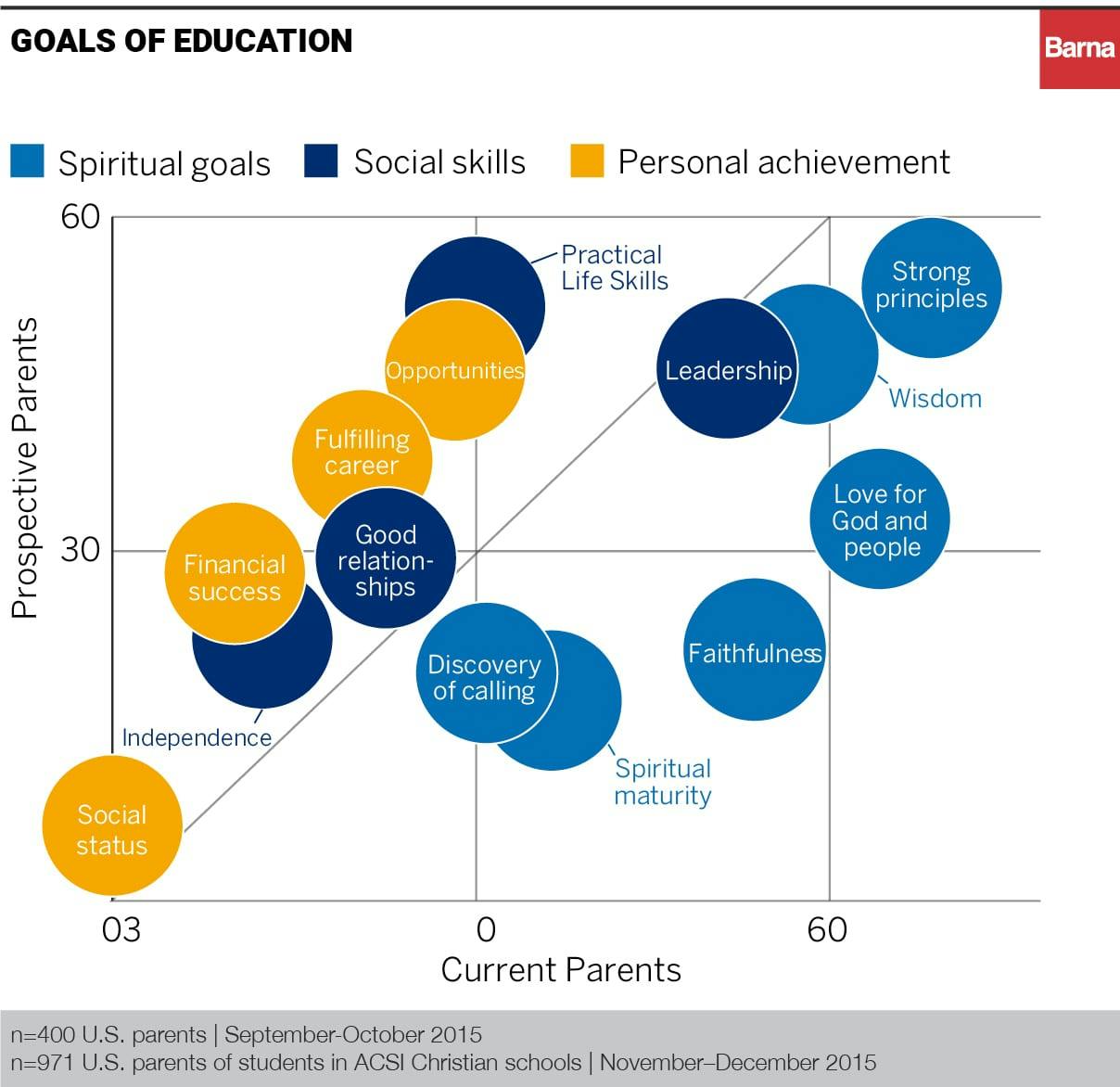
When it comes to what they consider to be the goals or ultimate purpose of education, parents of both current ACSI students and prospective students want more for their children than a list of accomplishments or path to wealth. Parents clearly think of schools as meeting a complex range of student and family needs. Of course, that includes academic subjects. It also includes other ways of developing and nurturing children.

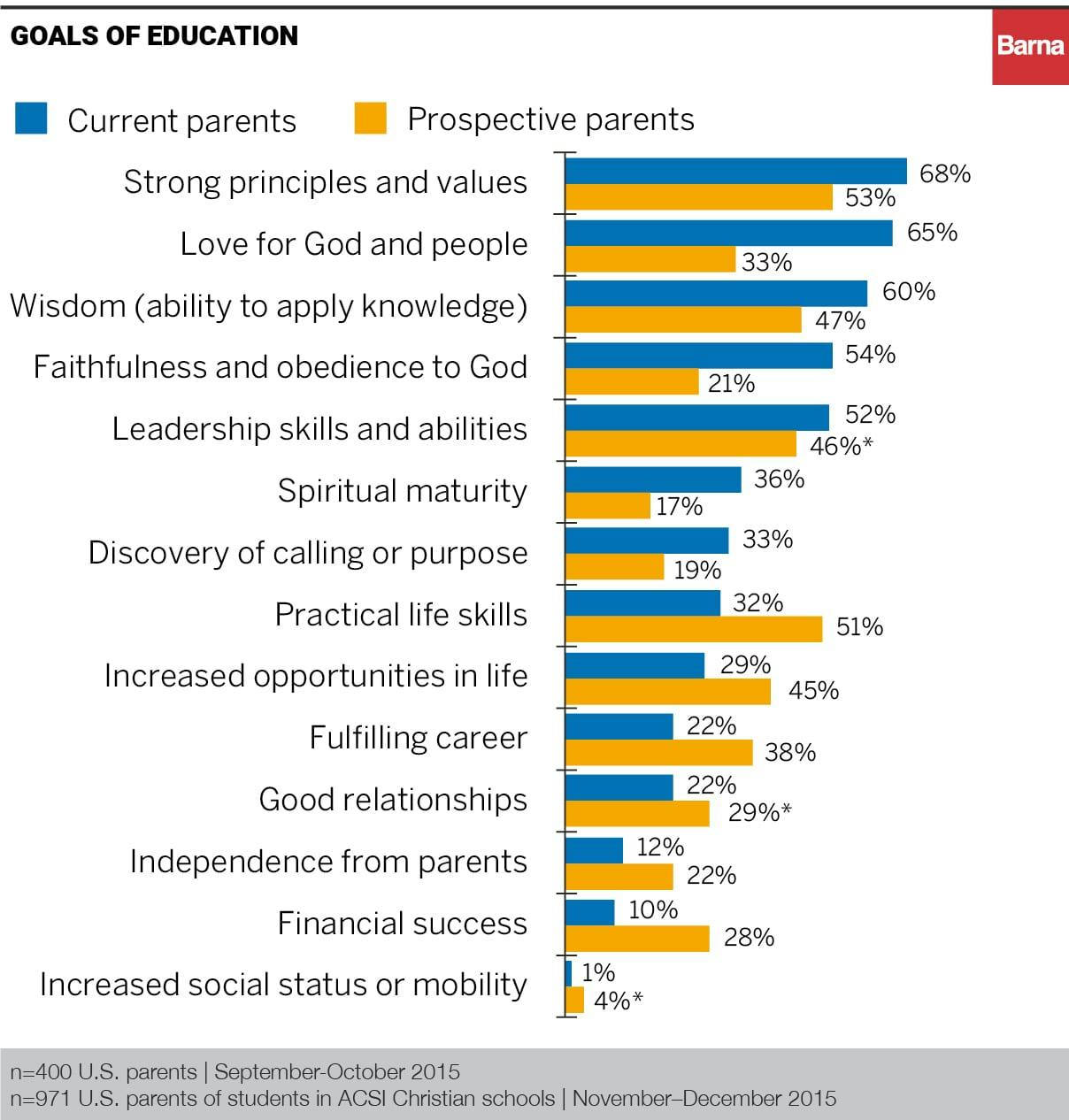
Barna asked these parents to choose the top five purposes of education. For both groups of parents, the most selected goal of education is to instill strong principles and values (current: 69%, prospective: 53%).

The most selected goal of Christian education is to instill strong principles and values. CLICK TO TWEET

There are some key differences however. Prospective parents are more focused on objectives related to personal achievement and social skills like “practical life skills” (51% compared to 31%), “increased opportunities in life” (45% compared to 29%), and a “fulfilling career” (38% compared to 22%). On the other hand, parents of current students place a higher priority on spiritual goals and a lower value on personal achievement. As a group, the ACSI parents believe education is primarily for developing a child’s character and spirituality, then academics and career. They do not believe education’s ability to raise a child’s socioeconomic status is nearly as important.

In addition to instilling strong principles and values, a majority of parents of current students place a high priority on five goals that include “love for God and other people” (65% compared to 33%), the “ability to apply their knowledge” (referred to as wisdom) (60% compared to 47%), “faithfulness and obedience to God” (54% compared to 21%) and “leadership skills” (52% compared to 46%).

What Parents Want in Schools
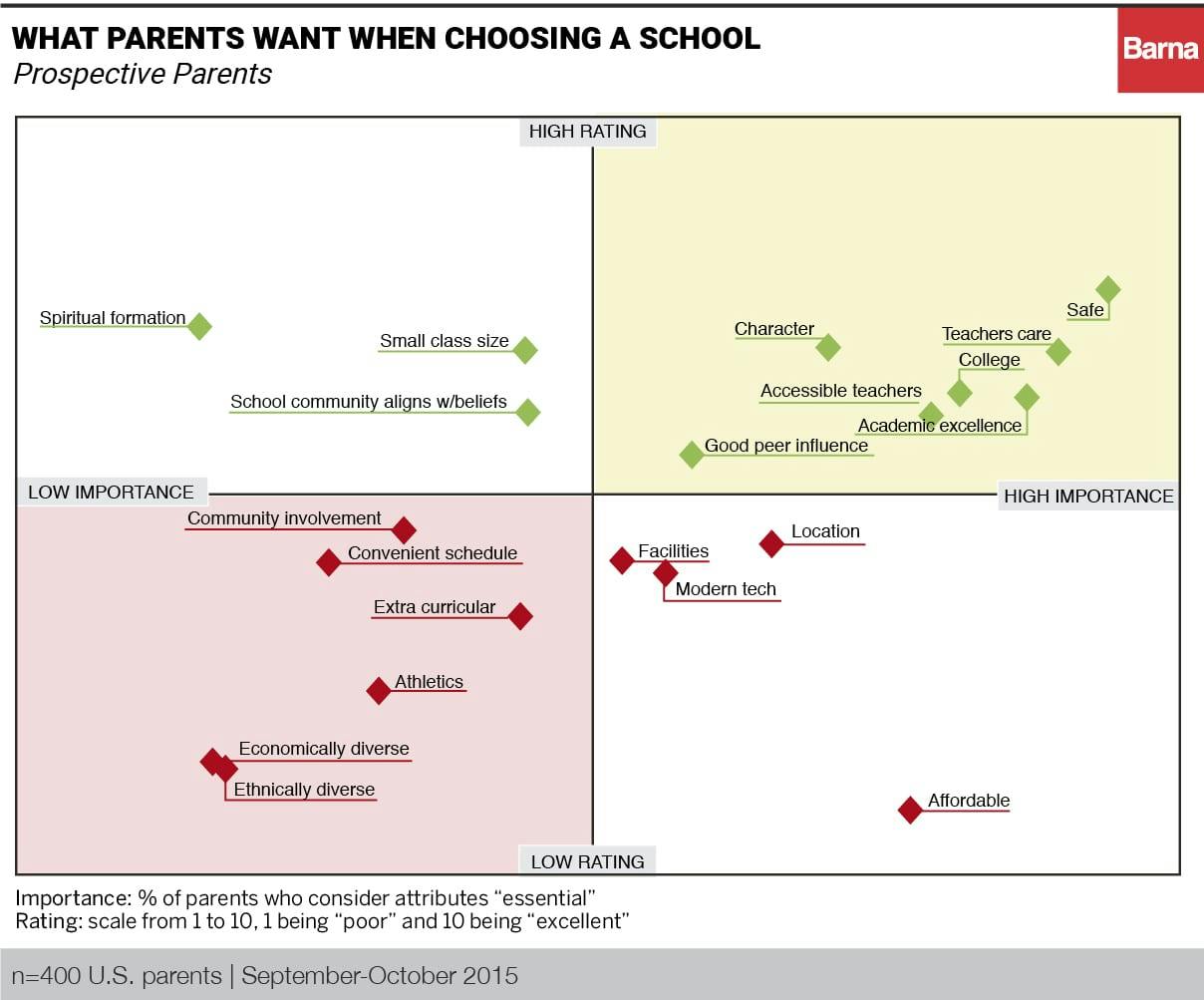
Most parents are looking for a school that aligns with their general ideas about education—what a school should do. However, parents’ specific priorities when it comes to choosing a school seem to reveal another side to what they value in an education—what a school should be like.

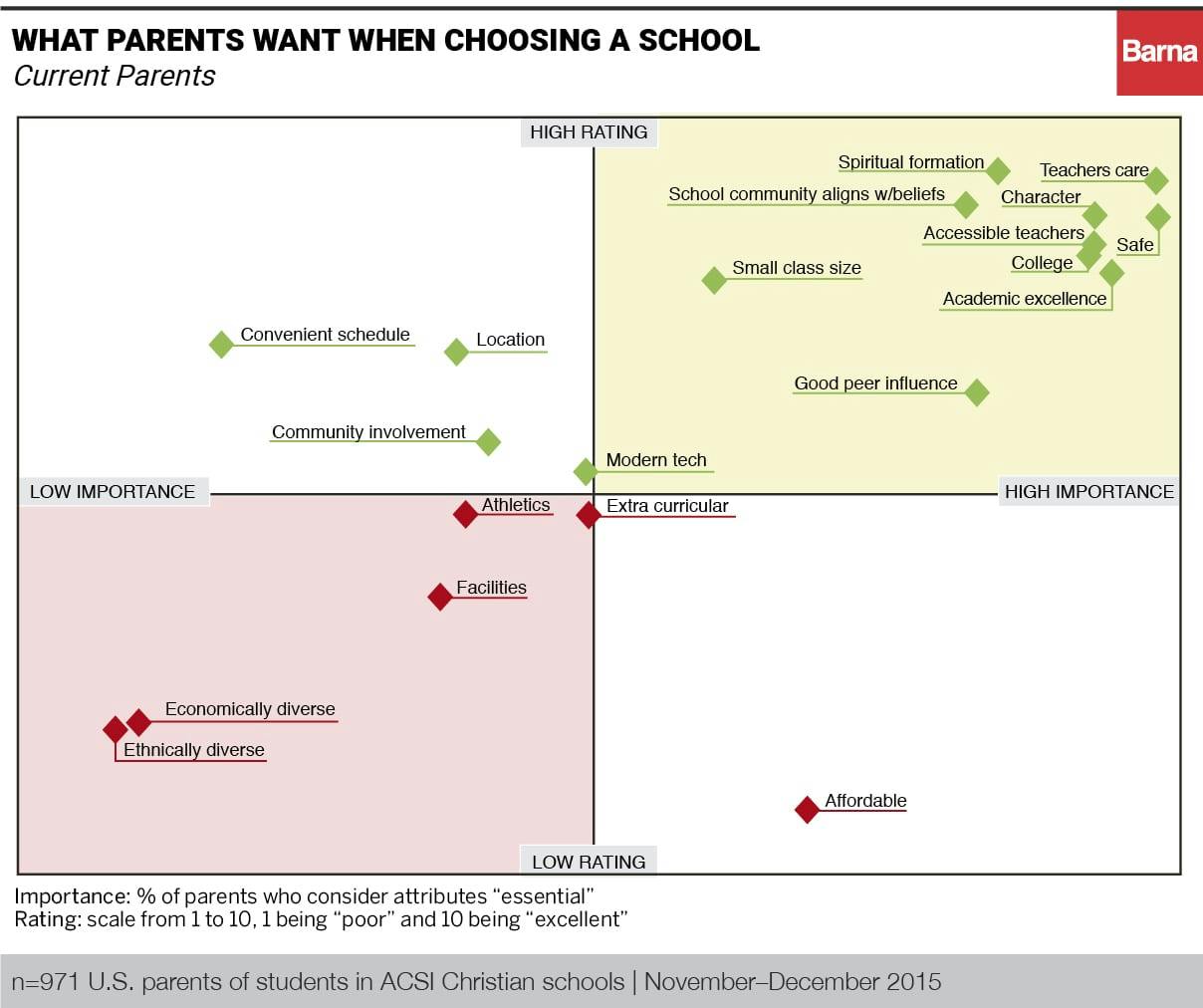
Safety’s first. Next come quality teachers, academic excellence and character development. Barna asked parents to rate 23 characteristics of a school from “essential” to “nice to have” to “not necessary.” What follows is a detailed look at the top four characteristics that are most important to parents.

1. Safety
A safe environment is the most essential feature when choosing a school for parents of both current (98% essential) and prospective (94%) Christian school students. Safety can mean anything from a toxin-free building or a padded playground to bullying prevention. However, it can also include “cultural safety,” such as feeling safe to ask questions or express doubt, learning to work through differences or a general sense of belonging and respect.

A safe environment is essential to current and prospective parents of Christian school students. CLICK TO TWEET

Based on findings from qualitative research, parents considering sending their child to a Christian school are thinking of their children’s physical and emotional safety from other children in the school. However, parents with children currently in Christian schools are more likely to be thinking of the freedom to ask questions or raise doubts, like those related to their faith.

Among parents of current ACSI students, almost half (47%) rate their current school with a 10 of out 10 for providing a safe environment. Comparatively, only 4 percent rate charter schools and public schools in the same way. Prospective parents, though more generous toward public (21%) and charter schools (35%), also give private Christian schools (both 42%) a 10 of out 10 for their ability to provide a safe environment.

2. Quality Teachers
Children experience a wide range of relationships at school, but the core ones are with peers and teachers. Parents want warm teachers who they can reach easily. “Teachers who really care about their students” (98%) is the aspect of schools that ACSI parents are most likely to say is essential (tied with safety at 98%), followed closely by “accessible teachers,” which slightly fewer (94%) said was a necessity. Likewise, almost all prospective parents believe caring and accessible teachers (91 and 80 percent, respectively) are essential to schooling.

Parents—especially of ACSI students—generally want small class sizes for their children (current: 63%, prospective: 49%). It seems likely this aspect of a school might indicate to parents that their child will get the personal attention from teachers that nearly all deem crucial.

Parents whose children are in private Christian schools tend to rank their experience with the schools very highly. Almost six in 10 (59%) give their current school a 10 of out 10 for “Teachers who really care about their students” and over half (52%) give the same ranking to “accessible teachers.” For prospective parents, almost four in 10 (38%) gave a 10 out of 10 for “Teachers who really care about their students” and about one-third (34%) gave the same rating for “accessible teachers.”

Parents with kids in private Christian schools tend to rank their experience very highly. CLICK TO TWEET

3. Academic Excellence
Academic excellence is a top priority for parents of both current and prospective Christian school students. Nearly all current Christian school parents(95%)say it is essential. For prospective parents, that number is slightly lower, at 88 percent. Surprisingly, parents do not consider academic excellence more important as their children grow older and closer to the window for college admissions.

Current ACSI parents rate their schools quite well for academic excellence. More than one-third (38%) give their schools a 10 out of 10. Altogether, 86 percent rate the school a seven or above, and more than two-thirds of current parents choose “fosters excellence” to describe private Christian schools—ranking them far above other types of schools.

Fewer prospective parents share that view. They give lower scores to private Christian schools, with 29 percent saying that Christian private schools have the highest academic standards. It is not clear where this difference in perceptions comes from, except that those with a personal experience of ACSI schools have a much higher view of the schools’ academics.

4. Character Development & Spirituality
Current and prospective parents both also give high priority to “intentionally developing children’s character” (current: 94%, prospective: 73%). But in addition, current parents especially desire spiritual development for their children. This reinforces the above findings showing how most current Christian school parents believe that character and spiritual development are among the ultimate purposes of education.

When it comes to spiritual formation specifically, more than eight in 10 (82%) parents of current students believe it is essential when weighing a choice between different schools, but only one-quarter of parents of prospective students(26%) feel the same.

It seems that ACSI schools (private Christian schools) fulfill these expectations, especially for current parents. More than half of parents of current students gave Christian schools the highest score (10 of 10) for being deliberate about developing children’s character (59%) and spirituality (66%). In both categories, over 97 percent of parents give the schools a score higher than six out of 10.

Prospective parents rank Christian schools much lower on these two measures (35% gave a perfect 10 of 10 for character development and 42% gave a 10 of 10 for spiritual development). However, about three-quarters of prospective parents gave a score of six of 10 or better on those two dimensions of spiritual development.

Comment on this research and follow our work:
Twitter: @davidkinnaman | @roxyleestone | @barnagroup
Facebook: Barna Group

About the Research
A sample of ACSI schools invited parents to participate in these surveys. To qualify, parents had to have a decision-making role in their children’s education and to have at least one child enrolled in an ACSI school. The prospective parent survey went to a nationally representative group of adults who had children in grades K–11 (those with seniors in high school and no other children were not included). To be counted in the survey, they had to indicate that they would be open to sending their child to a private Christian school. There was no restriction on the religion of these parents. While this survey was offered to a nationally representative group, the group that met the qualifications was also different from an average collection of American parents. Read the full research report at ACSI.

About Barna
Barna research is a private, non-partisan, for-profit organization under the umbrella of the Issachar Companies. Located in Ventura, California, Barna Group has been conducting and analyzing primary research to understand cultural trends related to values, beliefs, attitudes and behaviors since 1984.

© Barna Group, 2017